


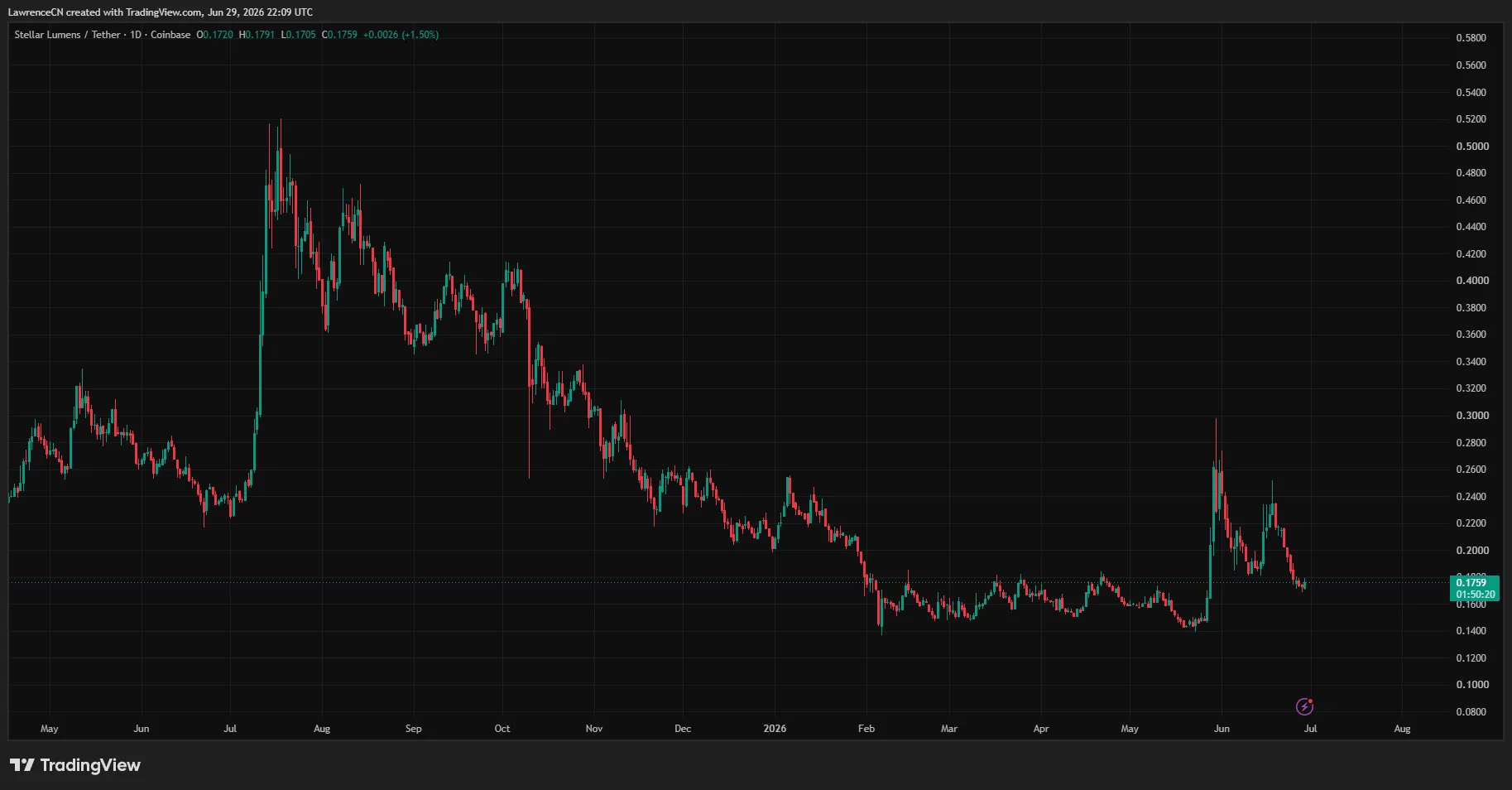
Stellar trades near $0.18, but a May 2026 plan for the DTCC to connect its tokenization service to Stellar, with XLM named as the settlement token, could route trillions in traditional securities onto the network. What would that actually mean for the price? Here is the realistic read, separating the landmark from the hype.
Summary
- Stellar trades near $0.18 as of late June 2026, down from a July 2025 high near $0.52, with the Fear and Greed reading in extreme fear despite strong network fundamentals. In May 2026, the DTCC, the backbone of United States securities settlement, announced it would connect its tokenization service to Stellar, with XLM designated as the settlement token and live assets targeted for the first half of 2027.
- The deal is a genuine long-term, high-conviction catalyst because it links potential institutional securities volume directly to the network, but the 2027 timeline means price until then is driven by speculation and sentiment.
- The central question for the price is value accrual: whether routing securities settlement through Stellar translates into sustained demand for the XLM token, a question complicated by XLM’s fixed supply with no burn mechanism.
- Year-end 2026 forecasts span roughly $0.18 at the bearish end to $1.20 to $2.50 in bullish models, a gap that turns on whether the DTCC and other catalysts begin converting fundamentals into token demand.
Stellar (XLM) is trading near $0.18 as of late June 2026, and it presents one of the sharpest disconnects in crypto: a network with strong and growing fundamentals attached to a token sitting near multi-year lows.
XLM is down from a July 2025 high near $0.52, the Fear and Greed reading is mired in extreme fear, and yet the underlying network is arguably healthier than ever, with tokenized real-world assets on Stellar having climbed past $2.83 billion, stablecoin payment volume around $5.5 billion, developer engagement at record highs, and consensus achieved in under six seconds through its Federated Byzantine Agreement design.
Into that gap between fundamentals and price landed the most consequential development in Stellar’s recent history: in May 2026, the Depository Trust and Clearing Corporation, the institution that sits at the center of United States securities settlement, announced it would connect its tokenization service to Stellar, with XLM named as the settlement token and live assets targeted for the first half of 2027.
The announcement raised an obvious and high-stakes question for anyone watching XLM: if the backbone of traditional securities settlement is routing tokenized assets through Stellar, what does that mean for the price of the token?
This article answers that question as realistically as possible, separating the genuine significance of the deal from the hype that inevitably surrounds it. It works through where Stellar stands now and why the fundamentals-price gap exists, what the DTCC deal actually is, why it could be a landmark, the all-important value-accrual question of whether network volume translates into token demand, the problem of the 2027 timeline, the other catalysts stacking up around XLM, the supply dynamics that complicate the bull case, what the analysts forecast, and three scenarios for the price.
The aim is to give XLM holders and observers a clear-eyed read rather than either dismissive skepticism or breathless promotion, because the DTCC deal is simultaneously a real, high-conviction catalyst and a development whose price impact is years away and structurally uncertain. The forecasts here are information, not advice. And the thread running through the whole analysis is the same question that haunts every payments-token valuation: does the network’s success actually accrue to the token, or can the volume flow through while the token is bypassed? For Stellar, the DTCC deal makes that question concrete and urgent.
Where Stellar stands and the fundamentals gap
Begin with the disconnect that defines XLM right now, because it is the context for everything the DTCC deal might change. Stellar near $0.18 is down significantly from its July 2025 high near $0.52, and the Fear and Greed reading sits in extreme fear, the same deeply pessimistic sentiment weighing on the broader crypto market.
On the charts, XLM has spent 2026 oscillating, with periods of consolidation around the high teens to low twenties in cents and sharp volatility, including swings of substantial magnitude within single months, but the broad trend has left the token near the lower end of its range and below where it traded a year ago. By the standard technical and sentiment measures, XLM looks like what it is: a beaten-down mid-cap altcoin in a fearful market.
What makes Stellar unusual is that its fundamentals tell a very different story from its price. The value of tokenized real-world assets issued on Stellar has surged past $2.83 billion, growing at a rapid clip, and stablecoin payment volume on the network has reached roughly $5.5 billion, both signs of genuine, growing utility rather than mere speculation. The network supports a large base of accounts and a wide array of fiat and crypto on-ramps, achieves fast and cheap settlement through its consensus design, and has added the Soroban smart-contract platform to enable tokenization and decentralized finance.
Developer engagement is at record levels. This is the crux of the Stellar investment debate: a network whose real-world usage and institutional positioning are strengthening, attached to a token whose price has fallen to multi-year lows. Bulls read the gap as a buying opportunity and evidence of accumulation, on the logic that price will eventually catch up to fundamentals. Skeptics read it as evidence that network usage does not reliably accrue value to the XLM token, which is precisely the question the DTCC deal forces to the center. The fundamentals-price gap is the setup; the DTCC deal is the potential catalyst that either closes it or exposes it as permanent.
What the DTCC deal actually is
To assess its impact, you have to understand precisely what was announced, because the details determine the significance. In May 2026, the Depository Trust and Clearing Corporation revealed plans to connect its tokenization service to the Stellar network. The DTCC is not a peripheral player; it is the central infrastructure of United States securities settlement, the institution through which an enormous share of the country’s stock and bond transactions are cleared and settled, handling quadrillions of dollars in securities annually across the traditional financial system. Its decision to build tokenization capability on a public blockchain at all is significant, and its selection of Stellar specifically, with XLM named as the settlement token for the infrastructure, is what makes the announcement material for the token. The plan targets live assets in the first half of 2027, meaning the connection is a forward-looking build rather than something already moving volume today.
The stated logic is that tokenization, representing traditional securities as digital tokens on a blockchain, can make settlement faster, cheaper, and programmable, and that Stellar’s compliance-focused, settlement-oriented architecture is suited to regulated finance. The phrase that captured attention is that the arrangement brings the potential for trillions in traditional securities onto the network over time, with XLM as the settlement token directly linking that future institutional volume to token demand. That is the bullish framing, and it is grounded in real fact: the DTCC genuinely chose Stellar, XLM is genuinely named as the settlement token, and the addressable volume is truly enormous. But three qualifications matter from the outset and shape the rest of this analysis.
First, the assets go live in 2027, not now. Second, the scale of what actually migrates onto Stellar, as opposed to the theoretical addressable market, is unknown. And third, and most important for the price, the mechanism by which settlement volume translates into sustained XLM demand is the contested value-accrual question instead of an automatic pass-through. The deal is real and large in potential; what it means for the token depends on details that are not yet settled.
Why it could be a landmark
Taken at its strongest, the DTCC deal is a genuine landmark, and the bull case for its significance deserves a full and fair statement. The first reason is validation. When the institution at the heart of United States securities settlement chooses to build tokenization infrastructure on Stellar, it is an endorsement of Stellar’s architecture for regulated, institutional finance that no marketing campaign could buy. It signals that Stellar’s long-standing bet on compliance and settlement, often overlooked during the speculative manias that drove other chains, is being recognized by exactly the kind of counterparty it was designed to serve. For a network whose pitch has always been institutional and payments-focused instead of retail-speculative, having the DTCC select it is the strongest possible third-party confirmation of the thesis.
The second reason is the direct linkage to token demand, at least in principle. Because XLM is named as the settlement token for the DTCC tokenization infrastructure, future institutional volume flowing through that infrastructure has a potential channel to XLM demand, unlike vaguer partnership announcements that leave the token’s role ambiguous. The third reason is scale and trajectory. The addressable market for tokenized securities is measured in the trillions, and even capturing a modest fraction would represent settlement volume far beyond anything Stellar handles today, which is why the deal is framed as a long-term, high-conviction bullish driver instead of a short-term price catalyst. It fits a broader pattern in which Stellar has positioned itself as compliance-ready infrastructure for tokenization, evidenced by its alignment with regulatory frameworks and its role hosting regulated stablecoins.
The strongest version of the bull case, then, is that the DTCC deal is the moment Stellar’s institutional thesis begins to be validated by the most credible possible counterparty, with a direct potential link to token demand and an addressable market large enough to transform the network’s economics. Whether that potential converts into token price is the next, harder question.
The value-accrual question
Here is where realism has to enter, because the gap between a network landmark and a token price runs straight through the value-accrual question, and Stellar’s situation has a cautionary parallel close at hand. The question is whether routing securities settlement through Stellar actually creates sustained demand for the XLM token, or whether the volume can flow through the network while the token captures little of the value. This is not a hypothetical concern invented for skepticism; it is the same question that has dogged XRP, where Ripple’s commercial success in cross-border payments has not reliably translated into XRP token appreciation, because much settlement activity can occur without participants holding the token for any meaningful duration. Stellar faces a structurally similar issue: a settlement token may be used transiently to bridge value during a transaction without anyone needing to hold XLM as a durable asset, in which case enormous settlement volume could produce only modest, fleeting token demand.
The specifics of how XLM is used in the DTCC infrastructure will determine which way this resolves, and those specifics are not yet fully clear. If XLM is required as a persistent bridge or reserve asset that institutions must hold to access the settlement rails, and if the volume is large, the demand could be substantial and sustained. If, instead, XLM functions as a momentary settlement medium that is acquired and released within transactions, or if stablecoins denominated in dollars do most of the actual value transfer while XLM plays a minimal technical role, then the token demand could be far smaller than the headline volume suggests.
The honest assessment is that the DTCC deal creates a potential channel for value to accrue to XLM, but it does not guarantee that it will, and the magnitude depends on technical and economic details that remain to be seen. This is the single most important caveat for anyone pricing XLM off the DTCC news. The deal could be a genuine landmark for the network and still deliver a muted token-price impact if the value-accrual mechanism is weak, exactly as has happened with XRP. The network’s success and the token’s success are related but not identical, and conflating them is the most common error in valuing payments tokens.
The 2027 timeline problem
Even setting aside the value-accrual question, the DTCC deal carries a timing problem that directly affects how it should be priced today. The plan targets live assets in the first half of 2027, which means that for the entire rest of 2026 and into early 2027, there is no actual DTCC settlement volume flowing through Stellar, only the anticipation of it. This matters because, until the infrastructure goes live and shows real volume, XLM’s price will be driven by speculation and sentiment about the future instead of by current flows, which makes it vulnerable to the same volatility that afflicts any narrative-driven asset. The market has already shown this dynamic, with XLM experiencing sharp moves and pullbacks, including a notable drop after a rally, as enthusiasm about the deal collided with the reality that nothing changes operationally for many months.
The timing problem cuts in two directions, and a fair analysis acknowledges both. On one hand, it tempers the near-term bull case: those expecting the DTCC deal to lift XLM’s price in 2026 are betting on sentiment and positioning instead of on actual usage, and sentiment can fade, reverse, or be overwhelmed by broader market conditions long before 2027 arrives. A deal that goes live in 18 months provides little support for a token if the broad crypto market stays fearful in the meantime.
On the other hand, the long runway means the catalyst is not yet spent: if and when the infrastructure goes live in 2027 and begins showing real volume, that could be a fresh, concrete catalyst at a point when much of the speculative anticipation may have faded, potentially providing an upside surprise to a token that the market had given up on.
For pricing XLM through the rest of 2026 specifically, the timeline problem means the DTCC deal is best understood as a long-term thesis underpinning the token instead of a near-term price driver, and that anyone buying XLM on the DTCC news in 2026 is making a multi-year bet whose payoff, if it comes, is concentrated in 2027 and beyond, contingent on the value-accrual question resolving favorably.
The other catalysts stacking up
The DTCC deal does not stand alone; it sits atop a cluster of other developments that collectively strengthen Stellar’s institutional thesis, and a complete picture has to account for them. The most important is the regulatory designation.
On March 17, 2026, United States regulators designated Stellar as a digital commodity, the same classification extended to a short list of major tokens, which removed a significant barrier by clarifying XLM’s legal status and making it eligible for custodial services from institutions that safeguard assets. That designation is foundational because it is what allows firms to build regulated products on Stellar and to hold XLM with legal confidence, and it underpins the DTCC deal and the others.
Building on it, CME Group XLM futures are expected during 2026, which would provide regulated derivatives infrastructure and a potential structural source of institutional demand and price discovery, and an Amundi fund and other institutional vehicles point to growing traditional-finance engagement with the token.
Several more developments round out the picture. Stellar is widely seen as a beneficiary of the CLARITY Act, the legislation that aims to codify digital-asset rules and that could advance in 2026, in the same way XRP is, since both are payment-focused tokens whose institutional adoption hinges on regulatory certainty. Stellar’s design aligns with European regulatory frameworks, evidenced by regulated stablecoins launching on the network, giving it a compliance posture suited to multiple jurisdictions. And the Soroban smart-contract platform expands what the network can host, broadening its addressable market into tokenization and decentralized finance.
The significance of this cluster is that the DTCC deal is not an isolated bet but part of a coherent institutional thesis: regulatory clarity through the digital-commodity designation and potential CLARITY Act passage, derivatives infrastructure through CME futures, traditional-finance vehicles through funds like Amundi’s, and the flagship tokenization linkage through the DTCC.
If the thesis works, these catalysts reinforce one another, with regulatory clarity enabling the institutional products that enable the volume that could drive token demand. The caveat from the value-accrual discussion still applies to all of them, but the breadth of the catalyst stack is itself a meaningful part of the bull case for XLM.
The supply picture that complicates the bull case
A factor specific to XLM that any honest price analysis must weigh is its supply structure, which cuts against the simplest bullish narratives in an important way.
Following a 2019 community vote, Stellar ended its annual token issuance, fixing the total supply near 50 billion XLM and removing the inflationary dilution that suppresses price appreciation on many rival networks. That fixed supply is truly favorable: it means new issuance does not constantly dilute holders, and if demand rises against a fixed supply, the price pressure is upward. To that extent, the supply structure supports the bull case, and it is a point bulls rightly emphasize.
But there is a crucial qualification that complicates the value-accrual story. Stellar has no token-burn mechanism that meaningfully reduces circulating supply as the network is used. On some networks, transaction activity burns tokens, so that rising usage automatically tightens supply and creates upward price pressure independent of speculative demand, a direct link between network use and token scarcity. Stellar lacks this channel at scale, which means that fee-driven demand from network activity does not automatically remove XLM from circulation.
The implication for the DTCC deal is significant: even if substantial securities settlement volume flows through Stellar, that activity will not, by itself, shrink the XLM supply the way a burn mechanism would, so 1 of the clearest channels through which network usage could force token-price appreciation is absent.
The price would have to rise through genuine, sustained holding demand for XLM as an asset, not merely through transactional throughput, which loops back to the value-accrual question. The fixed supply is a modest positive; the absence of a burn mechanism is a real limitation on how mechanically network success can translate into token-price gains. Together they mean XLM’s bull case depends more heavily on durable demand for the token itself than on raw volume, which raises the bar for the DTCC deal to move the price.
What the analysts forecast
The analyst forecasts for XLM in 2026 span an extraordinarily wide range, even by the standards of the other majors, and the spread maps directly onto the questions this article has raised. At the bearish end, the algorithmic forecaster CoinCodex reads Stellar as bearish on technical indicators and, strikingly, its model does not project XLM reaching $1 until 2047, treating the token as a slow-compounding asset that the current setup does not favor.
Other cautious forecasters cluster low: Traders Union’s model points to roughly $0.40 to $0.48 for year-end, and DigitalCoinPrice sees around $0.32, both well above current levels but far below the bullish targets and treating Stellar as an infrastructure asset that appreciates slowly instead of a narrative rocket. Base-case forecasts that assume regulatory clarity holds and tokenization grows at a moderate pace tend to land in a $0.25 to $0.50 band, a meaningful recovery from current levels without a breakout.
At the bullish end sit forecasters who weigh the institutional catalysts heavily. Coinpedia’s hybrid model is the most bullish of the major platforms for 2026, placing XLM in a moderate range of $1.20 to $1.80 and a stronger scenario toward $2.50 if it reclaims key resistance, explicitly anchoring the thesis in institutional adoption velocity, rising stablecoin and tokenized-asset volume, and the catalysts described above, with a longer-term 2030 target as high as $6.19 under favorable conditions.
CoinLore and others produce aggressive cycle targets in the range of roughly $0.50 to $1.69 for the year. The gap, from a model that does not see $1 until 2047 to 1 targeting $2.50 this year, is enormous, and it reflects exactly the unresolved questions: whether the DTCC deal and the other catalysts convert into token demand, whether the value-accrual mechanism is strong or weak, and whether the 2027 timeline leaves 2026 to sentiment.
The bullish forecasts assume the institutional thesis begins paying off in token demand; the bearish ones assume the fundamentals-price gap persists because usage does not accrue to the token. The forecasts cannot settle which is right; they can only show how much rides on the DTCC deal and its peers actually closing that gap.
Three scenarios for Stellar around the DTCC catalyst
Pulling the analysis into scenarios clarifies the range without pretending to certainty. In the bull scenario, the market begins to price the institutional thesis ahead of the 2027 go-live. Confidence grows that the DTCC deal, the digital-commodity designation, CME futures, and the broader catalyst stack will convert into real XLM demand, an altcoin-favorable phase arrives, and XLM recovers toward the $1.20 to $2.50 range that the most bullish credible models describe, with the fundamentals-price gap finally closing as anticipation of trillions in tokenized volume lifts the token. This path requires the market to look through the 2027 timeline and to bet that the value-accrual question resolves in XLM’s favor, and it leans on the breadth of the catalyst stack as the engine. It is achievable but conditional on a favorable read of exactly the questions that remain open.
In the base scenario, the most defensible central case, XLM recovers modestly to a $0.25 to $0.50 band. Regulatory clarity holds, the catalysts develop roughly on schedule, and the token grinds back up from its lows as the institutional thesis slowly gains credibility, but without a breakout, because the DTCC volume is not live until 2027 and the value-accrual mechanism remains unproven through 2026.
This recovery-without-breakout outcome fits the weight of base-case forecasting and reflects the reality that the biggest catalyst is years from delivering actual volume. In the bear scenario, the fundamentals-price gap persists or widens. The broad market stays fearful, the DTCC anticipation fades as 2027 stays distant, doubts deepen about whether settlement volume will ever accrue to the token given the no-burn supply structure, and XLM stalls in the $0.10 to $0.20 range or drifts lower, validating the bearish models that treat it as a slow-compounding asset. Which scenario unfolds depends on the broad market, the pace of the catalysts, and above all whether the market comes to believe that routing securities through Stellar will create durable demand for XLM. All 3 are live, and the DTCC deal is the pivot around which they turn, a genuine landmark for the network whose translation into token price remains the open question.
Frequently Asked Questions
What is the DTCC tokenization deal with Stellar?
In May 2026, the Depository Trust and Clearing Corporation, the central infrastructure of United States securities settlement, announced it would connect its tokenization service to the Stellar network, with XLM named as the settlement token and live assets targeted for the first half of 2027. The DTCC clears and settles an enormous share of United States securities transactions, so its decision to build tokenization capability on Stellar is a major institutional endorsement. The arrangement carries the potential to bring tokenized traditional securities onto the network over time, with XLM as the settlement token linking that future volume to potential token demand. It is a forward-looking build, not something moving volume today.
Will the DTCC deal make XLM’s price go up?
It could, but it is not automatic, and the timing and mechanism matter. The deal is a genuine long-term, high-conviction catalyst because it links potential institutional securities volume to the network with XLM named as the settlement token. But assets do not go live until the first half of 2027, so through 2026 the price is driven by speculation instead of actual flows. More fundamentally, whether settlement volume translates into sustained XLM demand is the contested value-accrual question: a settlement token can be used transiently without anyone holding it durably, and Stellar lacks a burn mechanism that would tighten supply as usage grows. The deal could be a landmark for the network and still deliver a muted token-price impact if value accrual is weak.
Why is Stellar’s price so low if its fundamentals are strong?
This is the central Stellar paradox. The network’s fundamentals are strong and growing, with tokenized real-world assets past $2.83 billion, stablecoin payment volume around $5.5 billion, record developer engagement, and fast, cheap settlement, yet XLM trades near $0.18, down from a 2025 high near $0.52, with sentiment in extreme fear. Bulls read the gap as a buying opportunity on the logic that price will catch up to fundamentals. Skeptics read it as evidence that network usage does not reliably accrue value to the XLM token, the same issue that has dogged XRP. The gap exists because network success and token-price appreciation are related but not identical, and the mechanism linking them for XLM is contested.
What is the value-accrual question for XLM?
It is whether routing activity like securities settlement through Stellar actually creates sustained demand for the XLM token, or whether volume can flow through the network while the token captures little value. A settlement token may be used transiently to bridge value within a transaction without anyone needing to hold XLM as a durable asset, in which case large settlement volume could produce only modest, fleeting token demand. This is the same question that has limited XRP’s price despite Ripple’s commercial success. For the DTCC deal, the magnitude of token-price impact depends on whether XLM is required as a persistent bridge or reserve asset or functions only as a momentary settlement medium, details that are not yet fully clear.
Does Stellar’s fixed supply help the price?
Partly, but with an important limitation. Following a 2019 community vote, Stellar ended annual issuance and fixed total supply near 50 billion XLM, removing the inflationary dilution that suppresses many rival tokens, which is favorable because rising demand against fixed supply creates upward price pressure. However, Stellar has no token-burn mechanism that meaningfully reduces circulating supply as the network is used. On some networks, transaction activity burns tokens so that rising usage automatically tightens supply; Stellar lacks this at scale, so fee-driven demand does not automatically remove XLM from circulation. The implication is that even large settlement volume will not shrink supply by itself, so the price must rise through durable holding demand instead of throughput, which raises the bar for catalysts like the DTCC deal
What are analysts forecasting for Stellar in 2026?
The range is extraordinarily wide. At the bearish end, CoinCodex’s model is bearish and does not project XLM reaching $1 until 2047, while Traders Union sees roughly $0.40 to $0.48 and DigitalCoinPrice around $0.32 for year-end, treating XLM as a slow-compounding infrastructure asset. Base-case forecasts that assume moderate growth cluster in a $0.25 to $0.50 band. At the bullish end, Coinpedia models $1.20 to $1.80 and up to $2.50 if resistance is reclaimed, anchored in institutional adoption, with a 2030 target as high as $6.19. The gap, from no $1 until 2047 to $2.50 this year, reflects the unresolved questions of whether the DTCC deal and other catalysts convert into token demand and whether the fundamentals-price gap finally closes.
This article is information, not financial or investment advice. Stellar price levels, network metrics, the DTCC announcement details, and analyst forecasts reflect data available as of June 28, 2026, are point-in-time, and can change. Cryptocurrency is highly volatile, and you can lose money. Price predictions are inherently uncertain, and the scenarios described are not guarantees. Do your own research and consult a qualified financial professional before making any investment decision.
