



Prediction market accuracy has suffered under both weak and excessive insider trading enforcement, according to a new academic study that argued a complete ban could leave markets less informative.
Summary
- A new academic study says a blanket insider trading ban could make prediction market prices less accurate by removing valuable information.
- The research argues that enforcement should vary based on how information is obtained, with the toughest penalties reserved for traders who can influence outcomes.
- Kalshi has introduced new compliance measures as regulators and lawmakers increase scrutiny of insider trading risks across prediction markets.
According to a June 2 research paper by Balbinder Singh Gill, assistant professor of finance at Stevens Institute of Technology, prediction markets work best under a middle-ground enforcement model rather than a zero-tolerance approach. The study developed an economic framework to examine how insider trading rules affect market participation and price accuracy.
Gill found that stricter enforcement can encourage more traders to participate by limiting insider advantages, but removing insiders entirely can also strip markets of valuable information. As a result, prediction market accuracy follows what the paper described as a “hump-shaped” pattern, improving as enforcement increases up to a point before declining when restrictions become too severe.
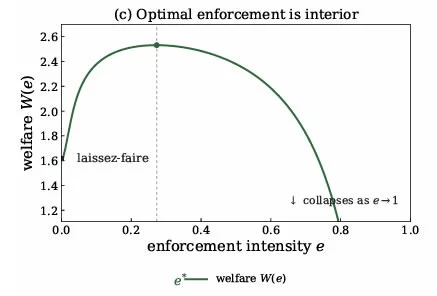
Source: Balbinder Singh Gill
The research arrives as regulators and lawmakers have intensified scrutiny of insider trading across prediction markets. In April, the Commodity Futures Trading Commission’s enforcement division warned that traders using non-public information could face enforcement action. A month later, U.S. House lawmakers opened an investigation into Kalshi and Polymarket over insider trading concerns.
Study argues for targeted enforcement
Rather than treating all insider activity the same way, the paper proposed different levels of enforcement based on the source of information.
Under the framework, traders who gain an informational edge through independent research should face little or no enforcement because punishing such activity could discourage information gathering that helps markets produce accurate prices.
A different standard should apply when information is obtained through leaks, stolen documents, classified material, or other forms of misappropriation, the study argued. In those situations, stronger enforcement is warranted because the informational advantage comes from unauthorized access rather than analysis.
At the highest end of the spectrum are participants who can directly influence an outcome they are betting on. According to the paper, those cases carry the highest manipulation risk and justify the toughest enforcement measures.
Recent investigations have highlighted those concerns. Federal authorities opened a probe into former U.S. Representative George Santos after Kalshi reported unusual trading activity linked to a market on whether he would attend the State of the Union address. Authorities alleged Santos publicly stated he would attend, placed a wager that he would not appear, and later skipped the event.
Following similar concerns, Kalshi imposed trading suspensions and financial penalties on local political candidates, including Virginia candidate Mark Moran and Minnesota candidate Matt Klein, after they placed bets on races in which they were competing. Such cases have drawn attention because the trader is not simply forecasting an event but may have the ability to influence the result itself.
Government agencies have also expanded enforcement against traders accused of using classified information. In April, the CFTC and the Department of Justice charged U.S. Army Master Sergeant Gannon Ken Van Dyke with using classified intelligence about a planned military operation targeting Venezuelan President Nicolás Maduro to trade on Polymarket.
According to enforcement filings, authorities relied on Section 746 of the Dodd-Frank Act, often referred to as the “Eddie Murphy Rule,” a provision originally designed to stop government employees from profiting from non-public government reports in commodity markets. The Van Dyke case represented the first known application of that authority to a prediction market platform.
Platforms and companies tighten controls
Even as researchers debate the appropriate level of enforcement, prediction market operators have begun introducing new safeguards.
As previously covered on crypto.news, Kalshi recently announced that users trading in certain sensitive markets, including those tied to corporate performance and national security events, may be required to disclose employment information. The company has also created a market-specific risk scoring system designed to identify contracts with elevated insider trading or manipulation risks.
Those changes followed recommendations from an internal audit committee and growing pressure from regulators and lawmakers.
Two recent cases cited in the study involved traders accused of profiting from privileged information on Polymarket. One involved a Google employee charged with using internal search trend information to earn approximately $1.2 million, while another involved a U.S. soldier accused of trading on classified military knowledge.
Outside the prediction market industry, legal advisers have warned corporations that event contracts are creating new risks around material nonpublic information.
Corporate law firms have advised companies to update compliance policies and employee handbooks, while some multinational firms are revising insider trading rules and non-disclosure agreements to explicitly cover prediction market activity.
As prediction markets continue to expand, with some financial firms projecting industry volumes could reach $1 trillion by 2030, the debate has increasingly centered on where regulators should draw the line between valuable information discovery and illicit use of privileged information.
Gill’s research suggests that eliminating insider participation entirely may come with costs of its own, potentially reducing the very price accuracy that prediction markets are designed to provide.
